How to Cut Your Ecommerce Shipping Costs by 15-30% (Without Sacrificing Speed)
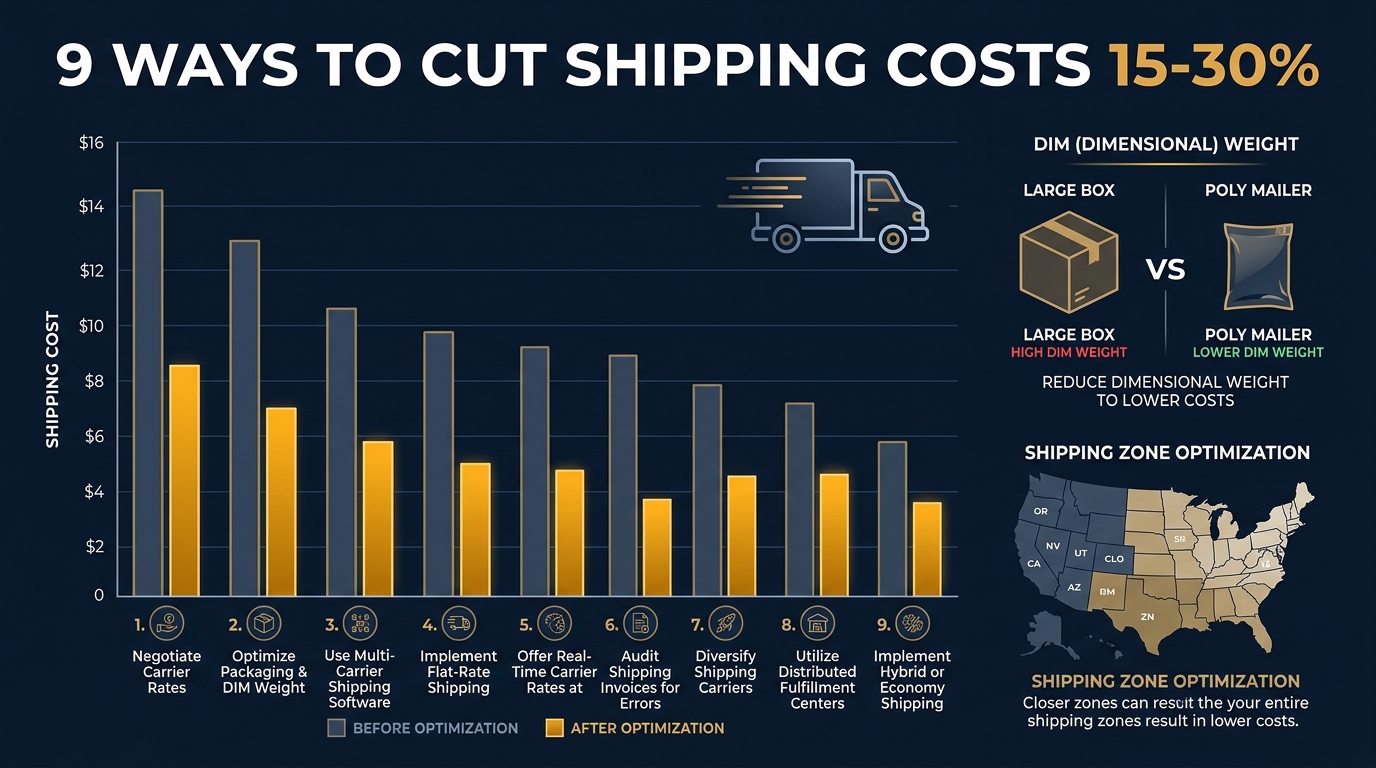
Shipping is 8-15% of revenue for most stores. Here are 9 tactics that cut costs without making customers wait longer.
Nguyen Tuan Dai
Founder & CEO, Okiela
Key Takeaways
- 1Shipping eats 8-15% of revenue for most stores -- a 20% reduction on $50K/month saves $800-$1,500/month ($9,600-$18,000/year)
- 2Shipping aggregators (Pirate Ship, ShipStation) beat direct carrier rates by 20-35% -- most small stores overpay because they use retail rates
- 3DIM weight pricing means box SIZE matters as much as weight -- switching from boxes to poly mailers can save $1.40-$2.80 per package
- 4No single carrier is cheapest for everything -- use a carrier mix (USPS First Class for under 1 lb, UPS/FedEx Ground for heavier packages)
- 5Three shipping tiers (free/standard/express) let 60-70% choose economy while express customers actually generate shipping profit
Table of Contents (12 sections)
- How Much Are You Really Spending on Shipping?
- Tactic 1: Negotiate Carrier Rates (Savings: 10-25%)
- Tactic 2: Use Shipping Aggregators (Savings: 15-35%)
- Tactic 3: Optimize Packaging Size (Savings: 10-20%)
- Tactic 4: Zone Skipping and Regional Fulfillment (Savings: 10-30%)
- Tactic 5: Flat Rate When It Wins (Savings: 5-15%)
- Tactic 6: Reduce Return Shipping Costs (Savings: $3-$8/return)
- Tactic 7: Right-Size Your Carrier Mix (Savings: 5-15%)
- Tactic 8: Ship on Off-Peak Days (Savings: 2-5%)
- Tactic 9: Offer Shipping Tiers (Revenue Recovery)
- The 30-Minute Shipping Audit
- The Bottom Line
Shipping is the silent profit killer of ecommerce.
For most Shopify stores, shipping costs eat 8-15% of revenue. On a $50K/month store, that is $4,000-$7,500 going to carriers every single month.
The frustrating part? Most founders accept shipping costs as fixed. They are not. With the right optimization, you can cut shipping costs by 15-30% without slowing delivery.
Here are 9 tactics, ranked by impact.
How Much Are You Really Spending on Shipping?
Before optimizing, know your numbers:
True shipping cost per order:
Total Shipping Cost = Carrier Fees + Packaging Materials + Fulfillment Labor + Returns Shipping + Insurance + Surcharges
Most founders only track carrier fees. But packaging ($0.50-$2.00/order), labor ($1.00-$3.00/order for self-fulfillment), and returns shipping ($3-$8/return) add 30-50% to the carrier charge.
Benchmark: Where should you be?
| Store Revenue | Healthy Shipping % | Danger Zone |
|---|---|---|
| Under $20K/mo | 10-15% | Above 18% |
| $20K-$50K/mo | 8-12% | Above 15% |
| $50K-$100K/mo | 6-10% | Above 12% |
| Above $100K/mo | 5-8% | Above 10% |
Tactic 1: Negotiate Carrier Rates (Savings: 10-25%)
This is the highest-impact tactic, and most small stores do not even try.
When to negotiate:
- You ship 50+ packages/month (most carriers will negotiate at this volume)
- You have been with the same carrier for 6+ months
- You can show shipping volume growth
What to ask for:
- Volume discount on your most-used service (Ground, Priority)
- DIM weight threshold increase (carriers charge by DIM weight above certain sizes)
- Surcharge waivers (residential delivery, fuel surcharges)
- Free carrier supplies (boxes, envelopes, tape)
Script:
"We ship approximately [X] packages per month, averaging [weight] and [zone distribution]. We are evaluating our carrier options and wanted to discuss volume pricing. Can you connect me with your small business pricing team?"
UPS, FedEx, and even USPS have dedicated account reps for businesses shipping 200+ packages/month.
Tactic 2: Use Shipping Aggregators (Savings: 15-35%)
If you ship fewer than 500 packages/month, aggregators almost always beat direct carrier rates.
Top aggregators for Shopify:
- Pirate Ship: Free, no markup, best for USPS and UPS
- ShipStation: Multi-carrier rate comparison + automation
- Shippo: Pay-per-label, good for low volume
- EasyPost: API-first, good for custom integration
Real comparison for a 2 lb package, Zone 5:
| Carrier/Method | USPS Retail | USPS via Pirate Ship | UPS via ShipStation |
|---|---|---|---|
| Price | $12.40 | $8.92 | $9.15 |
| Savings | — | 28% | 26% |
If you are paying retail rates on ANY carrier, you are overpaying by 20-35%.
Tactic 3: Optimize Packaging Size (Savings: 10-20%)
DIM weight pricing means the SIZE of your box matters as much as the weight. Carriers charge whichever is higher: actual weight or dimensional weight.
DIM weight formula:
DIM Weight = (Length × Width × Height) / DIM Factor
DIM factors: UPS/FedEx = 139, USPS = 166
Example:
A 12×12×12 inch box weighing 3 lbs:
- DIM weight: (12×12×12) / 139 = 12.4 lbs
- Actual weight: 3 lbs
- You pay for: 12.4 lbs (4x what the product actually weighs!)
Fix:
- 1Audit your top 5 products. Measure the actual product dimensions.
- 2Find the smallest box/mailer that fits with appropriate padding.
- 3Switch from boxes to poly mailers where possible (dramatically reduces DIM weight).
A clothing brand switched from 12×10×6 boxes to 14×10×2 poly mailers:
- DIM weight: 12×10×6/139 = 5.2 lbs → 14×10×2/139 = 2.0 lbs
- Savings: $1.40-$2.80 per package
- On 800 orders/month: $1,120-$2,240/month saved
Tactic 4: Zone Skipping and Regional Fulfillment (Savings: 10-30%)
Carrier prices increase dramatically with zone (distance). Zone 2 might cost $6, while Zone 8 costs $14 for the same package.
Options:
- 1Regional fulfillment centers: Split inventory across 2-3 locations to reduce average zone distance
- 2Zone skipping: Ship bulk to a regional carrier hub, then distribute locally
- 33PL with multiple warehouses: ShipBob, Deliverr, and Red Stag have multiple fulfillment centers
Impact example:
A store shipping from New York to all 50 states:
- Average zone: 5.2
- Average cost per package: $9.80
After adding a West Coast fulfillment center:
- Average zone: 3.1
- Average cost per package: $7.20
- Savings: $2.60/package = 26.5%
Tactic 5: Flat Rate When It Wins (Savings: 5-15%)
USPS Priority Mail Flat Rate is often the cheapest option for heavy, small items:
| Flat Rate Option | Price | Best For |
|---|---|---|
| Small Flat Rate Box (8.5×5.5×1.5) | $9.45 | Jewelry, small electronics |
| Medium Flat Rate Box (11×8.5×5.5) | $16.10 | Books, beauty products |
| Large Flat Rate Box (12.25×12×6) | $22.45 | Heavy items, multiple products |
| Padded Flat Rate Envelope | $9.65 | Clothing, flat items |
When Flat Rate wins: Items over 5 lbs going to distant zones. A 8 lb item from NY to CA might cost $18+ by weight but only $16.10 Flat Rate Medium.
When Flat Rate loses: Light items to nearby zones. A 1 lb item within your state ships for $5-$7 by weight vs $9.45 Flat Rate.
Tactic 6: Reduce Return Shipping Costs (Savings: $3-$8/return)
Returns are the hidden shipping cost. If your return rate is 10-15%, return shipping adds 1-2% of revenue in costs you probably do not track.
Tactics:
- 1Returnless refunds for items under $15: It costs $7-$10 to process a $12 return. Just refund it.
- 2Prepaid return labels at negotiated rates: Carriers offer 30-50% discount on return labels bought in bulk.
- 3Exchange-first policy: Offer store credit or exchange before refund — 30-40% of customers take the exchange.
- 4Smart sizing tools: Reduce clothing returns by 20-30% with accurate size guides and fit quizzes.
Tactic 7: Right-Size Your Carrier Mix (Savings: 5-15%)
No single carrier is cheapest for everything. The optimal strategy is a carrier mix:
| Package Type | Best Carrier (Usually) |
|---|---|
| Under 1 lb, any zone | USPS First Class |
| 1-5 lbs, zone 1-4 | USPS Priority or UPS Ground |
| 1-5 lbs, zone 5-8 | UPS Ground or FedEx Ground |
| Over 5 lbs, any zone | UPS/FedEx Ground |
| Over 70 lbs | Freight (not parcel) |
| International | DHL, USPS Priority International |
Use a shipping aggregator (Tactic 2) that auto-selects the cheapest carrier per shipment.
Tactic 8: Ship on Off-Peak Days (Savings: 2-5%)
Carriers add surcharges during peak periods:
- November-January: holiday peak surcharge ($1-$4/package)
- Sundays: additional handling surcharges
- Large packages during peak: additional oversized surcharges
Tactics:
- Batch ship Monday-Wednesday when possible
- Pre-ship holiday inventory to fulfillment centers before peak surcharges kick in
- Communicate "Order by Dec 15 for holiday delivery" to avoid rush surcharges
Tactic 9: Offer Shipping Tiers (Revenue Recovery)
Instead of one shipping option, offer three:
| Tier | Speed | Price | Your Cost |
|---|---|---|---|
| Economy | 7-10 days | Free (over $65) | $4.50 |
| Standard | 3-5 days | $5.99 | $7.00 |
| Express | 1-2 days | $14.99 | $12.00 |
Why this works:
- 60-70% choose free (economy) → you control costs
- 20-30% choose standard → $5.99 mostly covers your cost
- 5-10% choose express → you actually PROFIT on shipping ($2.99/order)
The 30-Minute Shipping Audit
Do this today:
- 1Minutes 0-10: Pull your last 100 shipments. Calculate actual cost per package (including packaging, not just carrier fees).
- 2Minutes 10-20: Compare your rate to aggregator rates (sign up for Pirate Ship — it is free — and rate-check 10 representative packages).
- 3Minutes 20-30: Measure your top 5 products and check if smaller packaging is possible.
The Bottom Line
Shipping costs are not fixed. They are negotiable, optimizable, and controllable. A 20% reduction in shipping on a $50K/month store saves $800-$1,500/month — that is $9,600-$18,000/year.
Upload your Shopify data to Okiela (free, 3 analyses/month) to see exactly what percentage of your revenue goes to shipping. The dashboard breaks down shipping as a line item in your profit waterfall, so you can see the impact immediately.
Find the hidden profit leaks draining your store.
Send one order export. Get your 3 biggest profit leaks back within 48 hours.
Request a free Profit Leakage AuditFree, founder-run, no pitch unless you ask. Every number labeled Verified or Estimated. Remove customer PII before upload.
Enjoyed this article?
Get weekly profit optimization tips and Okiela product news delivered to your inbox.
No spam. Unsubscribe anytime.
Nguyen Tuan Dai
Founder & CEO, Okiela
FP&A analyst building ecommerce tools on the side. Helping founders see their real numbers since 2025.