How to Negotiate Better COGS and Save 10-20% on Product Costs
Your COGS is the biggest single line item in your P&L. A 10% reduction goes straight to your bottom line. Here is how to negotiate it.
Nguyen Tuan Dai
Founder & CEO, Okiela
Key Takeaways
- 1COGS is 30-50% of revenue for most DTC brands -- a 10% reduction on $100K/month = $3K-$5K straight to profit every month
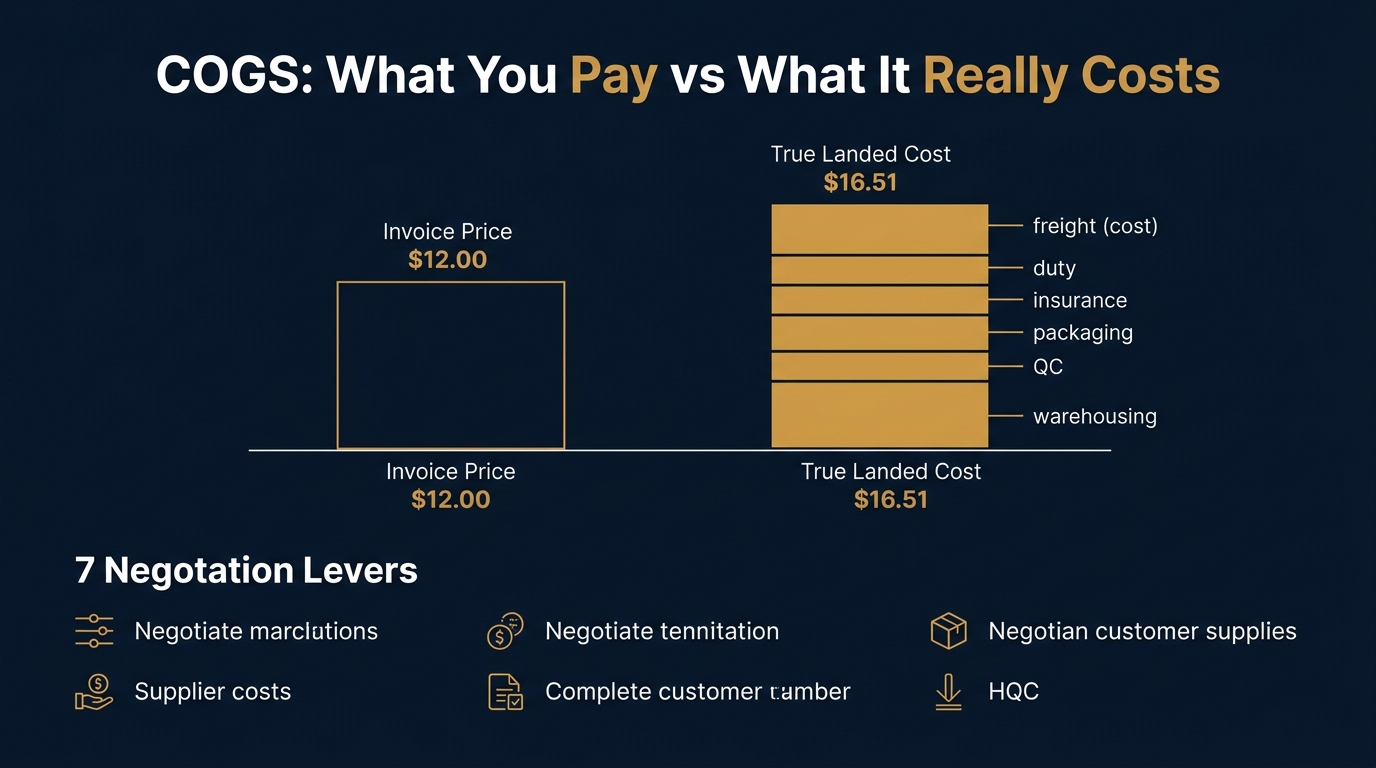
- 2True landed cost is 25-40% higher than invoice price when you add freight, duties, insurance, packaging, and defect allowance
- 37 negotiation levers: volume commitment, payment terms, MOQ reduction, annual price lock, quality guarantees, packaging consolidation, multi-supplier competition
- 4Net-30 payment terms on $20K/month orders = $20K free working capital -- this is essentially free financing from your supplier
- 5Renegotiate at 5 key moments: after 3 orders, at 2x volume, annually, when materials drop, and before a big launch
Table of Contents (7 sections)
If you run an ecommerce store, COGS (Cost of Goods Sold) is almost certainly your biggest expense. For most DTC brands, COGS is 30-50% of revenue.
That means a 10% reduction in COGS on a $100K/month store is $3,000-$5,000 straight to your bottom line. Every single month. No additional sales needed.
Yet most founders I talk to have never seriously negotiated their product costs. They accepted the first price their supplier quoted and never revisited it.
This is, dollar for dollar, the highest-ROI activity you can do for your store.
Why Most Founders Leave Money on the Table
Three reasons:
1. They do not know their actual landed cost. Most founders know their unit price but not the true cost including freight, duties, insurance, packaging, and defect allowance. You cannot negotiate what you cannot measure.
2. They negotiate once and stop. Suppliers expect annual renegotiations. If you are not asking, you are overpaying by 5-15% compared to their other customers who do.
3. They negotiate on price alone. The smartest negotiators get value through payment terms, MOQ flexibility, quality guarantees, and priority production — not just unit price.
Step 1: Calculate Your TRUE Landed Cost
Before you negotiate, you need to know exactly what each unit costs you. Most founders only look at the invoice price. The real cost is much higher.
Landed cost formula:
True Landed Cost = Invoice Price + Freight per Unit + Duty & Tariffs + Insurance + Packaging + QC & Defect Allowance
Example: A $12.00 product from a Shenzhen supplier:
| Component | Cost | % of Total |
|---|---|---|
| Invoice price | $12.00 | 66.3% |
| Freight (sea, per unit) | $1.80 | 9.9% |
| Import duty (6.5%) | $0.78 | 4.3% |
| Insurance | $0.12 | 0.7% |
| Packaging upgrade | $0.60 | 3.3% |
| QC reject allowance (3%) | $0.36 | 2.0% |
| Inbound receiving | $0.45 | 2.5% |
| Warehousing (first month) | $0.40 | 2.2% |
| Total Landed Cost | $16.51 | 100% |
That $12 product actually costs you $16.51 — 37.6% more than the invoice price. Now you know what you are actually negotiating.
Step 2: The 7 Negotiation Levers
Price is just one lever. Here are all seven:
Lever 1: Volume Commitment (5-15% savings)
Suppliers give better pricing for guaranteed volume. The key word is GUARANTEED — they need planning certainty.
Script: "We are projecting X units over the next 6 months. If I commit to a purchase order schedule, what pricing tier does that unlock?"
Do not bluff. Only commit what you can actually buy. But show them a growth trajectory.
Lever 2: Payment Terms (Free Cash Flow)
Net-30 or Net-60 terms are essentially free financing. If your supplier currently demands prepayment or COD, negotiate toward:
- 50% upfront, 50% on delivery → Net-15
- 30% upfront, 70% Net-30
- 100% Net-30 (after 3+ orders with good payment history)
The math: Net-30 on $20K/month orders = $20K free cash flow for 30 days. At $100K/month, that is $100K in working capital you do not need to finance.
Lever 3: MOQ Reduction (Flexibility)
If a supplier requires 1,000-unit MOQs and you only need 300, negotiate:
- Lower MOQ with slightly higher per-unit price (often 5-10% more but worth it for cash flow)
- Combined MOQ across multiple SKUs
- Split shipments from the same production run
Lever 4: Annual Price Lock (Protection)
Raw material costs fluctuate. Lock in pricing for 12 months:
Script: "I would like to lock in current pricing for the next 12 months, based on a commitment of X units total. Can we put that in writing?"
This protects you from 10-30% raw material spikes (which happen more often than you think — cotton, resin, and metals have all seen massive swings recently).
Lever 5: Quality Guarantees (Hidden Cost Reduction)
A 3% defect rate on 1,000 units means 30 wasted products. At $16.51 landed cost, that is $495/batch in losses. Negotiate:
- Defect rate cap (e.g., max 2%)
- Free replacements for defects above threshold
- Pre-shipment inspection at supplier cost
Lever 6: Packaging Consolidation (10-25% packaging savings)
If you buy packaging separately from product, you are likely overpaying. Ask your product supplier:
- Can they source and apply retail-ready packaging?
- Can they poly-bag or box at their facility?
- Can they include inserts or thank-you cards?
Consolidating packaging into the supplier reduces your per-unit packaging cost by 10-25% and eliminates a separate receiving step.
Lever 7: Multi-Supplier Competition
This is your ultimate leverage. Even if you love your current supplier, get quotes from 2-3 alternatives annually.
Script: "I have been quoted $X.XX from another certified supplier. I would prefer to continue working with you. Can you match or improve on this?"
You are not threatening. You are being transparent about market pricing. Good suppliers will sharpen their pencils.
Step 3: The Negotiation Email Template
Here is a template that has generated 8-15% savings for multiple founders I have worked with:
---
Subject: Volume Pricing Discussion — [Your Brand] Q3-Q4 2026
Hi [Name],
We have been working together for [X months/years] and are happy with the quality and service.
We are forecasting [X units] over the next 6 months across [Y SKUs]. Based on this volume commitment, I would like to discuss:
- 1Unit pricing for the projected volume
- 2Payment terms (we are currently [prepay/COD] and would like to move toward Net-30)
- 3Annual pricing lock for 2026-2027
For context, we have also received competitive quotes in the $XX.XX range for comparable quality. We prefer to continue with you, and I am hoping we can find terms that work for both sides.
Could we schedule a call this week to discuss?
Best,
[Your name]
---
The Compound Effect of Better COGS
A 10% COGS reduction compounds across your entire business:
| Metric | Before | After 10% COGS Cut |
|---|---|---|
| Revenue | $100K/mo | $100K/mo (same) |
| COGS (40% → 36%) | $40,000 | $36,000 |
| Gross profit | $60,000 | $64,000 |
| Operating expenses | $45,000 | $45,000 |
| Net profit | $15,000 | $19,000 |
| Margin | 15% | 19% |
| Annual impact | — | +$48,000 |
$48,000 more profit per year from one negotiation conversation. No new customers needed. No new products. No new ads.
When to Renegotiate
Mark these dates on your calendar:
- After your first 3 orders: You have payment history now. Ask for terms.
- When you hit 2x initial volume: Trigger volume pricing conversation.
- Annually (January or July): Standard renegotiation window.
- When raw materials drop: Track commodity prices for your products.
- Before a big launch: Leverage upcoming volume for better pricing.
The Bottom Line
COGS negotiation is the most overlooked profit lever in ecommerce. A 10% improvement goes directly to your bottom line with zero incremental work.
Upload your Shopify data to Okiela (free, 3 analyses/month) and see exactly what percentage of your revenue goes to COGS. Then use the scripts and framework above to bring that number down. The best time to negotiate was last year. The second best time is today.
Find the hidden profit leaks draining your store.
Send one order export. Get your 3 biggest profit leaks back within 48 hours.
Request a free Profit Leakage AuditFree, founder-run, no pitch unless you ask. Every number labeled Verified or Estimated. Remove customer PII before upload.
Enjoyed this article?
Get weekly profit optimization tips and Okiela product news delivered to your inbox.
No spam. Unsubscribe anytime.
Nguyen Tuan Dai
Founder & CEO, Okiela
FP&A analyst building ecommerce tools on the side. Helping founders see their real numbers since 2025.