The Real Cost of Processing Refunds in Ecommerce (It Is 3x What You Think)
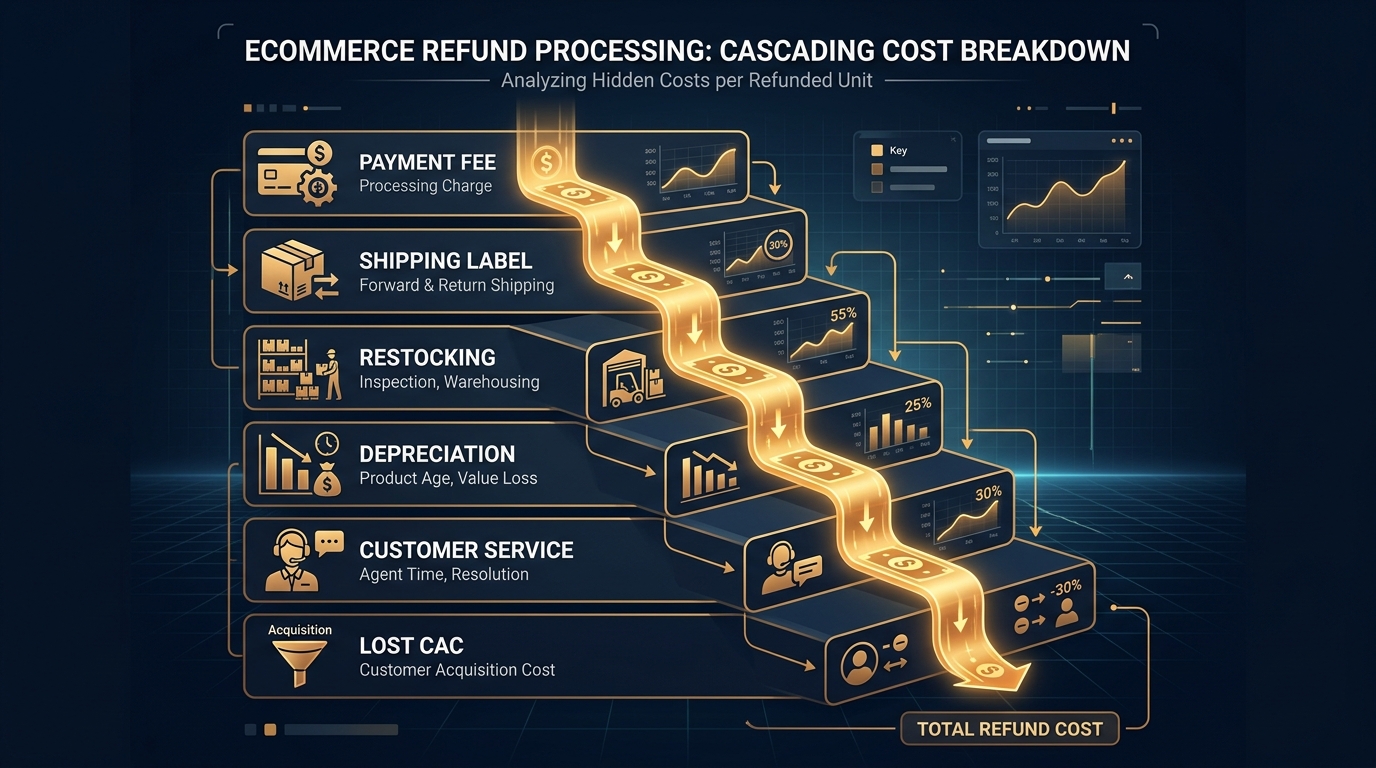
A refund is not just "giving money back." It is a 6-layer cost event that silently drains $4K-$12K/month from most Shopify stores. Here is the full breakdown.
Nguyen Tuan Dai
Founder & CEO, Okiela
Key Takeaways
- 1The real cost of processing a refund is $35-55 per return -- roughly 3x what most founders estimate
- 26 cost layers: payment fees, return shipping, restocking, depreciation, customer service, and lost CAC
- 3A 12% return rate on $100K/month revenue costs $81K/year in processing alone
- 4Exchange-first policies save 60-70% compared to cash refunds
- 5Track refund costs per SKU -- one product with 35% return rate can cause 40% of total refund costs
Table of Contents (11 sections)
- Why Most Founders Undercount Refund Costs
- Layer 1: The Refund Amount Itself
- Layer 2: Payment Processing Fees (Gone Forever)
- Layer 3: Return Shipping Label ($6-$14)
- Layer 4: Restocking and Quality Inspection ($3-$12)
- Layer 5: Inventory Depreciation (10-50% of COGS)
- Layer 6: Customer Service Time ($2-$7)
- The Full Cost Per Refund
- What This Looks Like at Different Revenue Levels
- 5 Ways to Reduce Refund Costs (Without Hurting Customer Experience)
- The Bottom Line
Last month I was on a call with a Shopify founder doing $120K/month. She told me her return rate was "totally fine" at 12%.
I asked her one question: "What does each refund actually cost you?"
She said: "The product cost. So about $18 per return."
The real number? $47 per return. She was off by 161%.
When we multiplied that by her monthly returns (about 170 units), she was losing $7,990 per month on refund processing. Not the refunded revenue -- that is obvious. The PROCESSING cost alone. The invisible part.
This is the most underestimated cost in ecommerce. So let me break it down layer by layer.
Why Most Founders Undercount Refund Costs
When you think "refund," your brain calculates: "I give back the purchase price. I get the product back. Roughly break even."
That mental model is dangerously wrong. A refund is not a single event. It is a chain of 6 separate costs, each pulling money out of your business. Most founders track zero or one of these. Let me walk through all six.
Layer 1: The Refund Amount Itself
This one is obvious. Customer paid $65, you refund $65. But here is what most people miss: you already paid to ACQUIRE that customer. Those ad dollars do not come back when the product does.
If your CAC was $25 for that customer, you did not just lose $65. You lost $65 plus the $25 you already spent to get them to buy. You are $90 in the hole before we even start counting the processing costs.
Layer 2: Payment Processing Fees (Gone Forever)
When the original sale happened, Shopify Payments charged you 2.9% + $0.30. On a $65 order, that is $2.19.
When you refund? Shopify gives the customer back $65. But Shopify does NOT give you back the $2.19 processing fee. It is gone.
This is the fee that nobody talks about. Every single refund has a minimum hard cost of 2.9% + $0.30 that you can never recover. On 170 monthly refunds at $65 average, that is $372/month in unrecoverable payment fees alone.
Real impact per year: $4,464 in payment fees on refunds that most stores never track.
Layer 3: Return Shipping Label ($6-$14)
If you provide prepaid return labels (and most competitive stores do), you are paying $6-14 per return depending on package weight and zone.
Some stores let customers keep the product for orders under $25 (it is often cheaper than paying for return shipping). Smart move, but it means you lose the entire COGS too.
For the average Shopify store:
- Prepaid return label: $8.50 average
- Carrier pickup fee (if applicable): $2-4
- Label printing/admin: $0.50
Total shipping cost per return: $9-$13
Layer 4: Restocking and Quality Inspection ($3-$12)
The product comes back. Now what?
Someone has to open the package, inspect the item, determine if it can be resold, re-tag it, photograph it if the condition changed, and put it back on the shelf.
For a small team, this is 10-20 minutes per return. At $20/hour labor cost, that is $3.50-$6.50 per item.
For beauty or electronics products that require seal verification or functionality testing, double it.
Average restocking cost per return:
- Simple apparel: $3-$5
- Boxed products: $5-$8
- Electronics/beauty: $8-$12
Layer 5: Inventory Depreciation (10-50% of COGS)
This is the biggest hidden cost. A returned product is rarely worth what it was before it shipped.
Opened packaging drops resale value by 15-30%. Seasonal items returned after the season can lose 40-60% of value. Products with broken seals (supplements, beauty) often cannot be resold at all.
Realistic depreciation rates:
- Apparel (tags still on): 10-15% depreciation
- Apparel (worn/washed): 40-60% (often unsellable as new)
- Electronics (opened box): 20-30%
- Beauty/wellness (opened): 80-100% (write-off)
- Seasonal items (returned late): 30-50%
On a product with $18 COGS, even 20% depreciation is $3.60 per return. At 50%, it is $9.
Layer 6: Customer Service Time ($2-$7)
Every return involves at least one customer interaction: the return request email or chat, processing the RMA, answering "where is my refund?" follow-ups, and potentially handling an exchange instead.
Average customer service cost per return interaction:
- Self-service portal (automated): $0.50-$1
- Email support: $3-$5
- Live chat: $4-$6
- Phone support: $6-$10
Most stores average $3-5 per return in customer service costs.
The Full Cost Per Refund
Let me stack it all up for a $65 order with $18 COGS:
| Cost Layer | Amount |
|---|---|
| Payment processing fee (non-refundable) | $2.19 |
| Return shipping label | $8.50 |
| Restocking + inspection | $5.00 |
| Inventory depreciation (25%) | $4.50 |
| Customer service time | $4.00 |
| Lost CAC (sunk cost) | $25.00 |
| Total cost per refund | $49.19 |
That is nearly $50 per return -- on top of refunding the original $65.
For the founder I mentioned at the start? 170 returns/month x $47 average = $7,990/month or $95,880/year in refund processing costs alone.
Her "12% return rate that is totally fine" was actually bleeding almost $96K per year.
What This Looks Like at Different Revenue Levels
| Monthly Revenue | Return Rate | Monthly Returns | Cost Per Return | Monthly Refund Cost | Annual Impact |
|---|---|---|---|---|---|
| $30,000 | 8% | 48 orders | $35 | $1,680 | $20,160 |
| $50,000 | 10% | 83 orders | $40 | $3,320 | $39,840 |
| $100,000 | 12% | 150 orders | $45 | $6,750 | $81,000 |
| $200,000 | 15% | 375 orders | $50 | $18,750 | $225,000 |
Even at a "low" 8% return rate on $30K/month, you are spending over $20K/year on refund processing. Most stores have no idea this line item exists.
5 Ways to Reduce Refund Costs (Without Hurting Customer Experience)
1. Reduce Returns at the Source
The cheapest return is the one that never happens.
- Better product photos (360-degree views reduce apparel returns by 20-25%)
- Sizing guides with real measurements (reduces size-related returns by 30%)
- Customer reviews with photos (social proof reduces "not what I expected" returns)
- Honest product descriptions (over-promising creates returns)
2. Offer Exchange-First Instead of Refund-First
When a customer initiates a return, offer an exchange or store credit before processing a cash refund. Many customers are happy with a different size or color.
Exchanges keep the revenue in your business. A $65 exchange costs you maybe $15 in shipping. A $65 refund costs you $50.
3. Set Smart Thresholds for "Keep It" Returns
For products under $25-30 in COGS, it is often cheaper to let the customer keep the item and send a replacement or refund. You save $8-13 in return shipping alone, plus restocking costs.
Do the math per SKU. If the return shipping + restocking cost exceeds the product COGS, a "keep it" policy actually saves money.
4. Track Refund Costs Per SKU
This is critical. Your overall return rate might be 10%, but one specific product might have a 35% return rate. That single SKU could be responsible for 40% of your refund processing costs.
Upload your data to Okiela. The profit engine breaks down costs per SKU, including return-adjusted margins. You can see exactly which products are bleeding money through returns.
5. Build Return Costs Into Your Pricing
If your return rate is 12%, you need to price your products assuming that 12% of units sold will come back at a cost of $40-50 each. This is not being greedy. It is being realistic.
Formula: Required per-unit return reserve = (Return Rate x Average Cost Per Return) / (1 - Return Rate)
At 12% return rate and $45 per return cost: $45 x 0.12 / 0.88 = $6.14 per unit you should build into your pricing to cover refund processing.
The Bottom Line
A refund is not "giving money back." It is a 6-layer cost event:
- 1Non-refundable payment fees
- 2Return shipping
- 3Restocking and inspection
- 4Inventory depreciation
- 5Customer service time
- 6Lost customer acquisition cost
For most Shopify stores, the total processing cost per refund is $35-55 -- roughly 50-80% of the refunded amount.
If you are not tracking this, you are making pricing and ad spend decisions based on profit margins that are 5-15% higher than reality.
Upload your Shopify export to Okiela and see your return-adjusted profit per SKU in 30 seconds. The free plan includes 3 analyses per month. Sometimes the scariest number is the one you have never calculated.
Find the hidden profit leaks draining your store.
Send one order export. Get your 3 biggest profit leaks back within 48 hours.
Request a free Profit Leakage AuditFree, founder-run, no pitch unless you ask. Every number labeled Verified or Estimated. Remove customer PII before upload.
Enjoyed this article?
Get weekly profit optimization tips and Okiela product news delivered to your inbox.
No spam. Unsubscribe anytime.
Nguyen Tuan Dai
Founder & CEO, Okiela
FP&A analyst building ecommerce tools on the side. Helping founders see their real numbers since 2025.
Related Articles
Hidden Shopify Fees That Quietly Kill Profit — And How to Check Them (2026)
12 min read
Why Your Shopify Revenue Is Up but Profit Is Down (The $953K Gap Explained)
11 min read