How to Calculate Your Cash Runway as an Ecommerce Founder (Before It Is Too Late)
If your monthly burn rate is $8,000 and you have $22,000 in the bank, you have 2.75 months of runway. That is not comfortable. Here is the exact formula and what to do about it.
Nguyen Tuan Dai
Founder & CEO, Okiela
Key Takeaways
- 1Cash runway = Cash in Bank / Monthly Net Burn -- this tells you exactly how many months you can survive at current rate
- 2Minimum comfortable runway for ecommerce is 3 months -- target 6 months because inventory lead times and seasonal dips eat cash fast
- 3A skincare brand growing 30%/month went from 7.8 months runway to 1.0 month in just 90 days of profitable growth
- 4When runway drops below 3 months: (1) cut non-essential expenses, (2) accelerate collections, (3) restructure supplier terms
- 5Monday morning 5-minute check: bank balance + expected in - expected out = weekly runway -- more valuable than any P&L report
Table of Contents (8 sections)
Cash runway is the single most important number in your business that you are probably not tracking.
It tells you exactly how many months you can survive at your current spending rate before the money runs out. It is not a projection. It is not an estimate. It is a countdown.
Every ecommerce founder should know their cash runway the same way a pilot knows their fuel level. When it drops below a certain threshold, you take action immediately — not when the engine sputters.
The Cash Runway Formula
Cash Runway (months) = Cash in Bank / Monthly Net Cash Burn
Where:
Monthly Net Cash Burn = Total Monthly Cash Out - Total Monthly Cash In
If you spend more than you bring in, you are burning cash. The runway is how long that burn can continue.
Important: This Is Cash, Not Profit
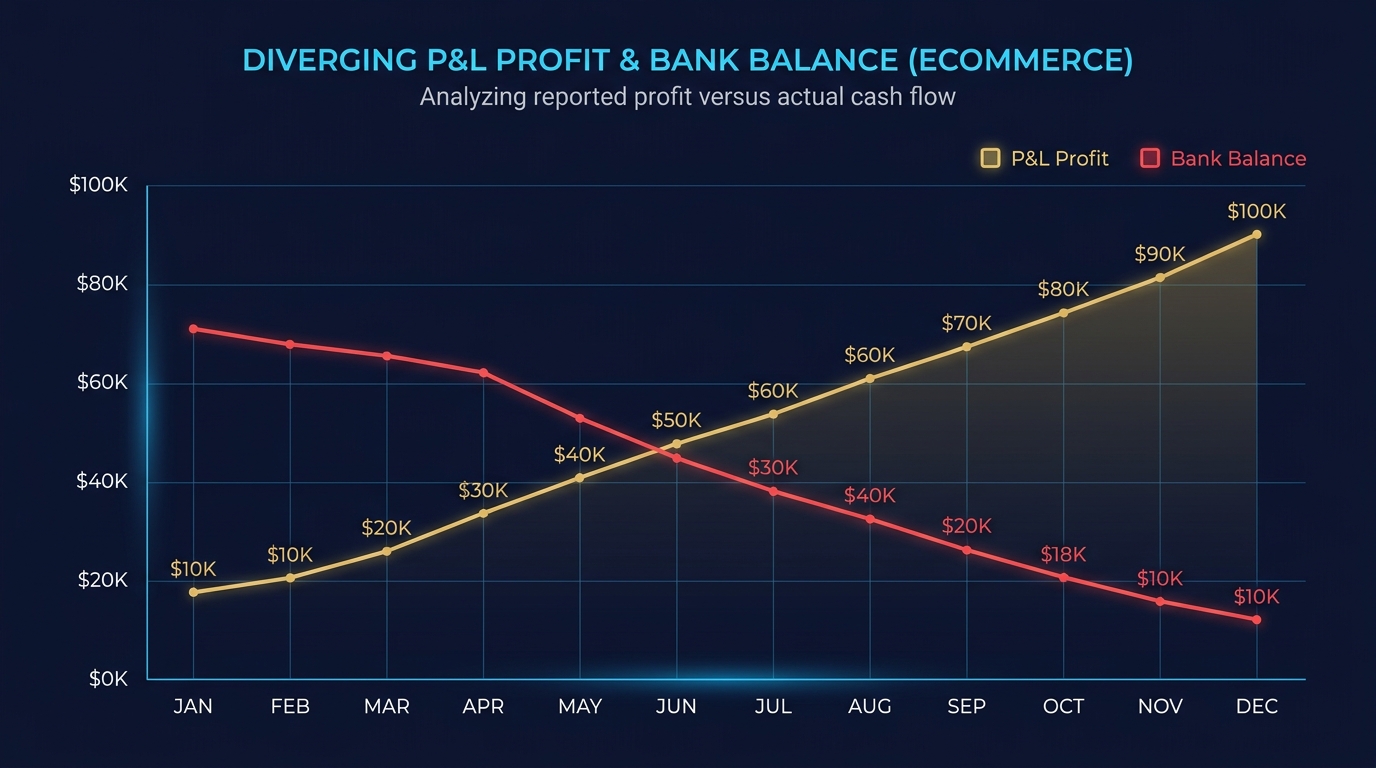
Do not use your P&L profit to calculate runway. As we covered in the cashflow article, profit and cash are different numbers. You need actual bank balance and actual cash movements.
| Metric | Where to Find It | What to Use |
|---|---|---|
| Cash in Bank | Your business checking account balance right now | Current balance |
| Cash In | Shopify deposits + other revenue over last 3 months | Average monthly deposits |
| Cash Out | All business expenses over last 3 months | Average monthly total spending |
Step-by-Step Calculation
Step 1: Sum All Monthly Cash Inflows
Add up everything that puts cash into your business bank account each month. Average the last 3 months for accuracy.
| Cash Inflow | Monthly Average |
|---|---|
| Shopify Payments deposits | $45,000 |
| PayPal deposits | $3,200 |
| Other income (wholesale, affiliate) | $1,800 |
| Total Cash In | $50,000 |
Step 2: Sum All Monthly Cash Outflows
Every dollar that leaves your business account. Average the last 3 months.
| Cash Outflow | Monthly Average |
|---|---|
| Inventory purchases | $18,000 |
| Ad spend (Meta, Google, TikTok) | $12,000 |
| Shipping & fulfillment | $5,500 |
| Payroll / contractors | $6,000 |
| Shopify + apps subscriptions | $800 |
| Rent / warehouse | $2,000 |
| Insurance | $200 |
| Software & tools | $500 |
| Other expenses | $1,000 |
| Owner pay / distributions | $4,000 |
| Total Cash Out | $50,000 |
Step 3: Calculate Net Burn
Net Cash Burn = $50,000 out - $50,000 in = $0/month
This store is breakeven on a cash basis. No burn, but no buffer either.
Step 4: Calculate Runway
If the bank balance is $22,000 and net burn is $0:
Runway = $22,000 / $0 = Infinite (but fragile)
This looks fine — until a bad month happens. If revenue drops 20% ($50K → $40K) while expenses stay at $50K:
New burn = $50,000 - $40,000 = $10,000/month
New runway = $22,000 / $10,000 = 2.2 months
Two months and one week. That is all the time you have to fix the problem.
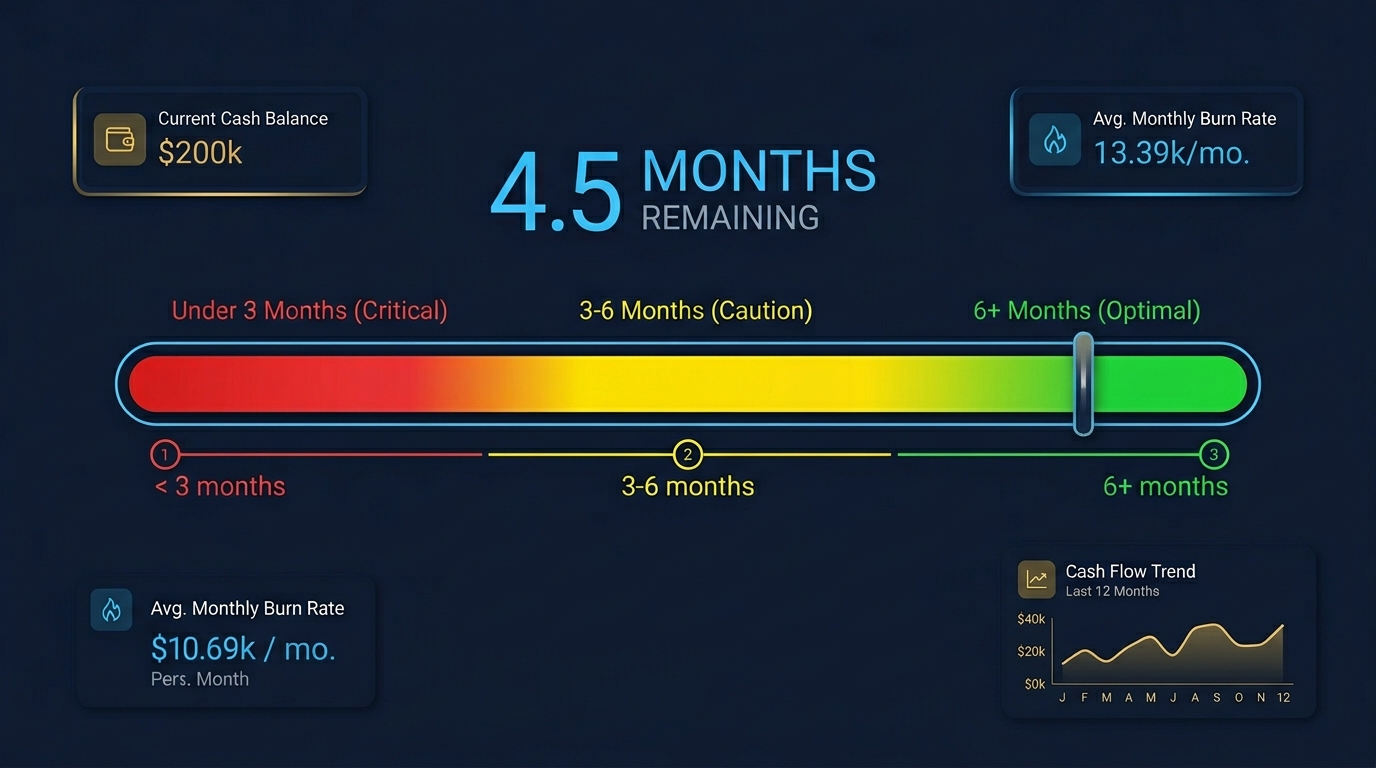
What "Good" Runway Looks Like
| Runway | Status | Action |
|---|---|---|
| 6+ months | Healthy | Invest in growth (ads, new products, team) |
| 3-6 months | Watch closely | Build cash reserves, cut non-essential spend |
| 1-3 months | Danger zone | Emergency cost cuts, accelerate collections |
| Under 1 month | Critical | Survival mode — cut everything except core operations |
For ecommerce specifically, 3 months is the minimum comfortable runway because:
- Inventory orders have 4-8 week lead times (you need cash to place next month's order)
- Seasonal dips can last 6-8 weeks
- A supplier issue or shipping delay can freeze your revenue for 2-4 weeks
- Ad platform bans can take 1-2 weeks to resolve (and kill revenue instantly)
Target: 6 months of runway at all times. If you are a seasonal business, 9-12 months.
Real Example: The Growth Trap
A skincare brand was growing 30% month over month. Everything looked amazing on the P&L.
| Month | Revenue | Expenses | Profit (P&L) | Cash In | Cash Out | Net Cash |
|---|---|---|---|---|---|---|
| January | $30,000 | $25,000 | $5,000 | $28,000 | $32,000 | -$4,000 |
| February | $39,000 | $33,000 | $6,000 | $36,000 | $45,000 | -$9,000 |
| March | $50,700 | $42,000 | $8,700 | $47,000 | $58,000 | -$11,000 |
Profit was increasing every month. Cash burn was also increasing because:
- Inventory orders were growing ahead of revenue (ordering for the NEXT month's growth)
- Ad spend increased to fuel growth
- They hired a fulfillment person in February
Starting bank balance: $35,000.
| Month | Opening Cash | Net Cash | Closing Cash | Runway |
|---|---|---|---|---|
| January | $35,000 | -$4,000 | $31,000 | 7.8 months |
| February | $31,000 | -$9,000 | $22,000 | 2.4 months |
| March | $22,000 | -$11,000 | $11,000 | 1.0 month |
In three months of profitable, growing business, runway went from nearly 8 months to 1 month. By April, they had to choose between paying their supplier or paying their ad bill. They chose ads, the supplier froze their account, and they could not fulfill orders for 3 weeks.
The business survived. But it lost 2 months of momentum, $15,000 in missed revenue, and the founder's mental health.
This story repeats itself thousands of times every year. Growth without cash management is the most dangerous phase of ecommerce.
The 3 Cash Runway Levers
When runway drops below 3 months, pull these levers in order:
Lever 1: Cut Expenses (Immediate Impact)
Start with the largest non-revenue-generating expenses:
- Reduce inventory orders to 2-week supply instead of 4-6 weeks
- Pause "nice to have" app subscriptions ($200-400/month saved instantly)
- Reduce or pause ad spend on low-ROAS channels
- Delay non-critical hires or contract work
- Reduce owner distributions to minimum living expenses
Expected impact: 15-30% reduction in monthly burn within 1 week.
Lever 2: Accelerate Cash In (1-4 Week Impact)
- Switch to Shopify Payments daily payouts if available
- Run a flash sale on slow-moving inventory (converts dead stock to cash)
- Offer a pre-order discount on next month's products (cash in before you buy inventory)
- Send payment reminders on outstanding wholesale invoices
- Negotiate early payment discounts with B2B customers
Expected impact: 10-25% increase in monthly cash inflow within 2-4 weeks.
Lever 3: Restructure Obligations (2-8 Week Impact)
- Negotiate extended payment terms with suppliers (Net-30 → Net-60)
- Call your credit card company and negotiate lower rates or temporary lower minimums
- Consolidate high-interest debt
- Apply for a line of credit (do this BEFORE you need it — banks do not lend to desperate businesses)
- Consider revenue-based financing (Clearco, Wayflyer) for inventory — expensive but faster than going broke
Expected impact: Extends runway by 1-3 months by spreading obligations.
The Weekly Runway Check
Every Monday morning, in 5 minutes:
- 1Check business bank account balance
- 2Note expected Shopify deposits this week
- 3Note bills due this week
- 4Calculate: (Balance + Expected In - Expected Out) / Average Weekly Burn
- 5If runway drops below 12 weeks (3 months): trigger Lever 1 action plan
Write these numbers down. A simple spreadsheet tracking Week, Opening Balance, Cash In, Cash Out, Closing Balance, and Runway gives you more financial visibility than 90% of ecommerce founders have.
Seasonal Adjustments
Ecommerce is seasonal. Your runway calculation should reflect this:
- Pre-Q4 (Aug-Sep): Cash out spikes for inventory buildup. Runway naturally drops. This is expected — but it should not drop below 2 months.
- Q4 (Oct-Dec): Cash in spikes from holiday sales. Build reserves for Q1.
- Q1 (Jan-Mar): Revenue dip + return processing + tax payments. This is when stores die. You need the Q4 reserves.
- Q2-Q3 (Apr-Sep): Stabilize and rebuild runway to 6+ months before the next Q4 cycle.
If your Q1 runway is below 3 months, you did not save enough from Q4. Commit to reserving 20-30% of Q4 profits for Q1 survival.
What Okiela Shows You
When you upload your Shopify data to Okiela, the 5-level profit waterfall gives you the clearest picture of where your money goes between GMV and True Profit:
- L1 → L2 shows how much returns and discounts reduce your top line
- L2 → L3 shows COGS consuming your revenue
- L3 → L4 shows variable costs (shipping, payment fees, returns processing)
- L4 → L5 shows ad spend and fixed costs taking the final cut
This does not replace cash tracking, but it shows you the PROFIT reality — and when profit and cash diverge, the waterfall shows you exactly where the leaks are.
Upload your Shopify data for free (3 analyses/month). Know your real profit first, then build your cash management on top of it. The founders who survive are the ones who track both numbers.
Find the hidden profit leaks draining your store.
Send one order export. Get your 3 biggest profit leaks back within 48 hours.
Request a free Profit Leakage AuditFree, founder-run, no pitch unless you ask. Every number labeled Verified or Estimated. Remove customer PII before upload.
Enjoyed this article?
Get weekly profit optimization tips and Okiela product news delivered to your inbox.
No spam. Unsubscribe anytime.
Nguyen Tuan Dai
Founder & CEO, Okiela
FP&A analyst building ecommerce tools on the side. Helping founders see their real numbers since 2025.
Related Articles
Why Profit Is Not the Same as Cashflow (The #1 Mistake Killing Ecommerce Stores)
13 min read
The Ecommerce Cashflow Timeline: Why Cash Goes Out on Day 0 but Comes Back on Day 45
14 min read