How to Price Your Products When Ad Costs Keep Rising (2026 Playbook)
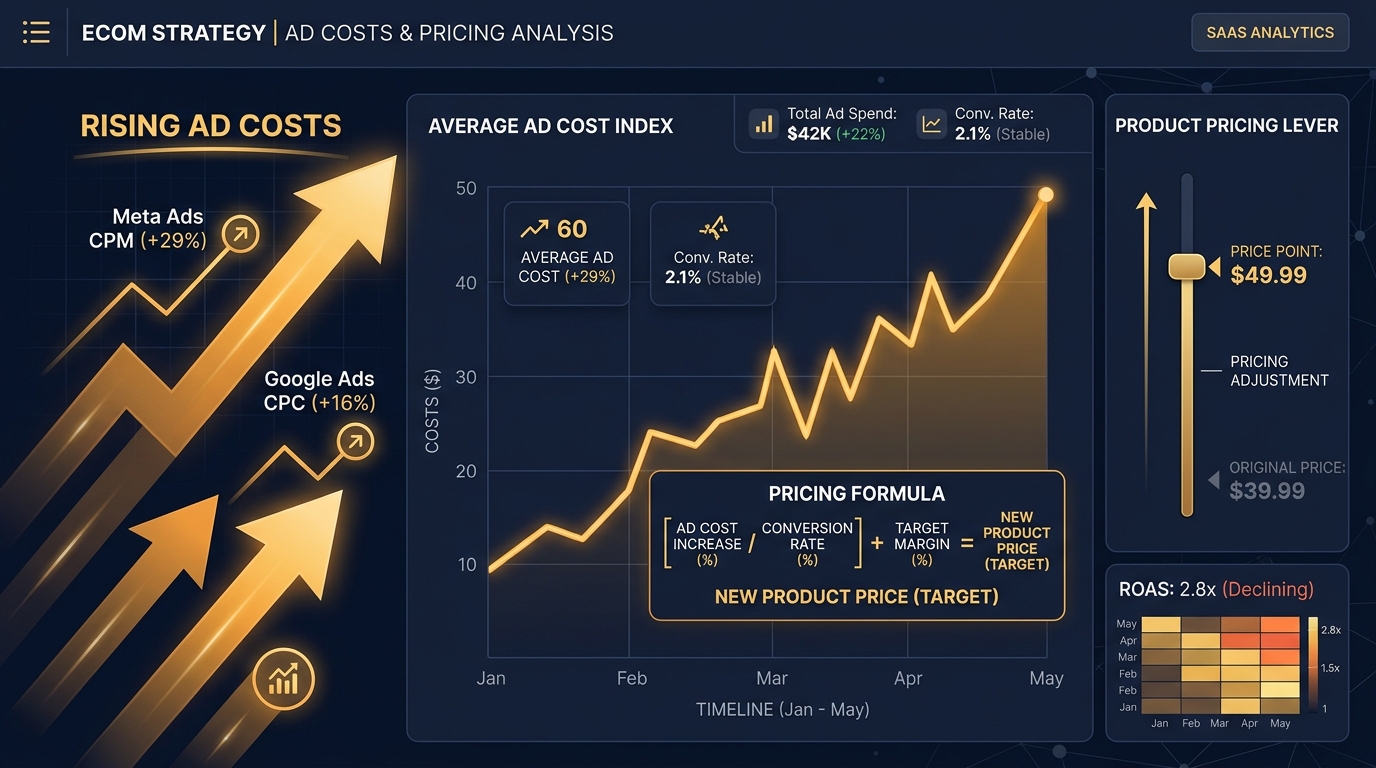
Meta CPM up 37%. Google CPC up 22%. Your margins are shrinking and your ROAS is lying to you. Here is the pricing framework that actually works when CAC is climbing.
Nguyen Tuan Dai
Founder & CEO, Okiela
Key Takeaways
- 1Meta CPM up 37%, Google CPC up 22% in 2026 -- pricing must adjust or margins collapse
- 2ROAS says nothing about profit. A 4x ROAS can still mean losing money per order
- 3CAC Breakeven Formula: (COGS + Shipping + Fees + CAC) / (1 - Target Margin)
- 4The 5/2 Rule: raise prices 5%, monitor for 2 weeks. Under 2% volume drop = keep it
- 5Build ad spend into pricing as a permanent cost, not a separate budget line
Table of Contents (7 sections)
A Shopify founder sent me his numbers last week. Same store, same products, same prices as last year. Revenue up 15%. Profit down 30%.
The culprit was obvious once you looked at the data: his Meta CPM had gone from $11 to $15. Google CPC from $1.20 to $1.55. His customer acquisition cost went from $38 to $54 per customer.
He did not change anything. The ad platforms did. And his pricing, which used to leave $12 per order in profit, was now leaving $3. Scale that across 800 monthly orders and you go from $9,600/month profit to $2,400.
This is not a unique story. It is the new normal.
The Ad Cost Problem in 2026
Here is what happened to ad costs over the past 2 years:
| Platform | 2024 Avg CPM | 2026 Avg CPM | Change |
|---|---|---|---|
| Meta (Facebook/IG) | $10.50 | $14.40 | +37% |
| Google Display | $3.40 | $4.60 | +35% |
| TikTok | $6.50 | $9.20 | +42% |
| Google Shopping | $0.95 CPC | $1.16 CPC | +22% |
For context, if your ad costs go up 37% but your product prices stay the same, your profit margin drops by that full 37% of your ad-spend-to-revenue ratio. If ads are 20% of your revenue, a 37% increase in ad costs wipes out 7.4 percentage points of profit.
That is the difference between a 18% margin and a 10.6% margin. Or, for many stores, the difference between profitable and not.
Why ROAS Lies to You About Pricing
Most founders use ROAS (Return on Ad Spend) as their north star. "I am getting 4x ROAS, everything is fine."
No. ROAS only tells you how much revenue you generated per dollar of ad spend. It says absolutely nothing about profit.
Here is the math most people get wrong:
Scenario A: "Good" ROAS, bad profit
- Product price: $50
- COGS: $20
- Ad spend per sale: $12.50 (4x ROAS)
- Payment fees: $1.75
- Shipping gap: $2.50
- Gross margin after all costs: $13.25 (26.5%)
- That looks fine.
Same scenario, 2026 ad costs:
- Ad spend per sale: $17.00 (2.9x ROAS)
- Gross margin after all costs: $8.75 (17.5%)
- You just lost 9 percentage points.
ROAS went from 4x to 2.9x. Your reporting tool says "ROAS declined." But what it does not say is that your per-order profit dropped 34% and you need to RAISE PRICES to compensate.
This is why the deep research consistently shows that "chasing ROAS" is one of the biggest profit traps in DTC. Competitors like BeProfit have been criticized for only counting "attributed" ad spend -- making ROAS look artificially better while real profit suffers.
The CAC Breakeven Formula
Before you can set prices intelligently, you need to know one number: your CAC breakeven price.
Formula:
CAC Breakeven Price = (COGS + Shipping + Payment Fees + Target CAC) / (1 - Target Profit Margin)
Let me use real numbers:
- COGS: $20
- Shipping cost: $8.50
- Payment fees: 3.2% of price + $0.30
- Target CAC: $54 (your current actual)
- Target profit margin: 15%
Working backward:
- Fixed costs per order: $20 + $8.50 + $0.30 + $54 = $82.80
- Payment fee: 3.2% of price
- Price = $82.80 / (1 - 0.15 - 0.032)
- Price = $82.80 / 0.818
- Price = $101.22
If your product is priced at $50 and your CAC is $54, you literally cannot make money at any ROAS. The math does not work. You need to either raise the price, lower the CAC, or cut other costs.
The 4-Step Repricing Framework for Rising Ad Costs
Step 1: Calculate Your Real Per-Order Profit (Current State)
Not the spreadsheet approximation. The real number.
Upload your last 3 months of Shopify data to Okiela. The profit engine calculates exact per-order profit after ALL costs -- including the allocated ad spend per order that most tools ignore.
If per-order profit is below $8-10, you have a structural pricing problem.
Step 2: Find Your Price-Insensitive Products
Not every product reacts the same way to price increases. Some products have elastic demand (raise price, volume drops a lot). Others are relatively inelastic (raise price, volume barely changes).
Price-insensitive products typically:
- Have few direct competitors at the same quality level
- Solve a specific pain point (not a commodity)
- Have strong reviews (social proof anchors perceived value)
- Are bought repeatedly (habit reduces price sensitivity)
These are your repricing candidates. Start here.
Step 3: Test Incrementally (The 5/2 Rule)
Raise prices by 5% on selected SKUs. Monitor for 2 weeks.
If volume drops less than 2%: The increase worked. Your revenue per unit went up and your profit per unit went up more. Do it again in 4 weeks.
If volume drops 2-5%: Calculate the net impact. In most cases, 5% price increase with 3% volume drop still increases total profit.
If volume drops more than 5%: Roll back to the previous price. Try a smaller increase (3%) or test a different SKU.
The key insight: a 5% price increase on a product with 20% margin increases your per-unit profit by 25%. You can afford to lose some volume and still come out ahead.
Step 4: Build Ad Costs Into Your Pricing Model Permanently
Stop treating ad spend as a separate budget line. It is a cost of goods sold -- just like your product cost and shipping.
New pricing formula:
Minimum Viable Price = (Landed COGS + Shipping + Payment Fees + Target CAC per Order + Return Cost Reserve) / (1 - Target Net Margin)
Review this quarterly as ad costs change. If Meta CPMs go up 10% next quarter, your minimum viable price goes up too. Adjust prices or kill unprofitable SKUs before you lose money for a full quarter.
Advanced Move: Shift Spend to Profitable Channels
If Facebook ads are getting expensive, do not just absorb the cost. Reallocate.
Channels ranked by typical 2026 profit-after-CAC for DTC:
- 1Email/SMS marketing -- CAC is almost zero for existing customers. Return on investment is 36:1 average.
- 2Organic SEO/Content -- Slower but CAC drops over time. A blog post that ranks costs $0 in ongoing CAC.
- 3Referral programs -- $10-15 effective CAC vs $54 on paid. Network your existing customers.
- 4TikTok organic -- Free reach still exists on TikTok in 2026 if your content is good.
- 5Meta/Google paid -- Still necessary, but should be your LAST dollar spent, not your first.
The founders who are winning in 2026 are the ones spending 60% of their marketing budget on retention and organic, and 40% on paid acquisition. Not the other way around.
What to Do This Week
- 1Calculate your current CAC. Total ad spend last 3 months divided by total new customers acquired. If you do not know this number, everything else is guesswork.
- 1Run the breakeven formula for your top 10 SKUs. How many are priced below breakeven at current CAC?
- 1Upload your data to Okiela. The AI identifies which specific SKUs cannot sustain current ad costs and recommends exact price adjustments. 30 seconds, free.
- 1Pick 3 SKUs to test a 5% increase. Start with your highest-volume products that have strong reviews and low return rates.
- 1Set a calendar reminder in 2 weeks to check the results. Volume drop under 2%? Raise another 5%.
The Mindset Shift
Your product price is not fixed. It is a variable that should change as your costs change.
When ad costs go up, you have exactly three options:
- 1Raise prices (protect margins)
- 2Cut ad spend and find cheaper channels (protect margins differently)
- 3Do nothing (watch margins erode)
Option 3 is what most founders choose by default. They just... do nothing and hope things get better. That is how $9,600/month profit turns into $2,400.
Do not be that founder. Run your numbers. Adjust your prices. Ad costs are not going down -- so your pricing needs to go up.
Find the hidden profit leaks draining your store.
Send one order export. Get your 3 biggest profit leaks back within 48 hours.
Request a free Profit Leakage AuditFree, founder-run, no pitch unless you ask. Every number labeled Verified or Estimated. Remove customer PII before upload.
Enjoyed this article?
Get weekly profit optimization tips and Okiela product news delivered to your inbox.
No spam. Unsubscribe anytime.
Nguyen Tuan Dai
Founder & CEO, Okiela
FP&A analyst building ecommerce tools on the side. Helping founders see their real numbers since 2025.