Pricing Psychology for Ecommerce: 7 Tactics That Increase Margin Without Losing Customers
You do not need to lower prices to sell more. These 7 psychology-backed pricing tactics increase both conversion and margin.
Nguyen Tuan Dai
Founder & CEO, Okiela
Key Takeaways
- 1Cost-plus pricing leaves 10-30% of margin on the table -- pricing is a psychology problem, not just a math problem
- 2Charm pricing (.99) still works: A/B tests show 6-12% higher conversion for sub-$100 products, but premium items convert better with round numbers
- 3The Rule of Three (Good/Better/Best) increases revenue per visitor by 31% -- 55% of customers choose the middle option
- 4Free shipping threshold set at AOV + 20-30% increases AOV by 12-18% and reduces cart abandonment by 8-15%
- 5Bundles beat discounts: they increase AOV without training customers to wait for sales and they move slow inventory alongside best sellers
Table of Contents (10 sections)
- Why Most Ecommerce Pricing Is Wrong
- Tactic 1: Charm Pricing (The $.99 Effect)
- Tactic 2: Price Anchoring (The Decoy Effect)
- Tactic 3: The Rule of Three (Good, Better, Best)
- Tactic 4: Free Shipping Threshold
- Tactic 5: Odd-Even Pricing by Category
- Tactic 6: Per-Day Pricing Reframe
- Tactic 7: Bundle Pricing (The Smart Discount)
- Putting It All Together: The Pricing Optimization Audit
- The Bottom Line
Most ecommerce founders think about pricing as a math problem. Cost plus markup equals price. Simple.
But pricing is actually a psychology problem. The same product at the same price can convert at wildly different rates depending on HOW you present that price.
And the best part? These tactics do not require lowering your prices. Most of them actually increase your margin while improving conversion.
Why Most Ecommerce Pricing Is Wrong
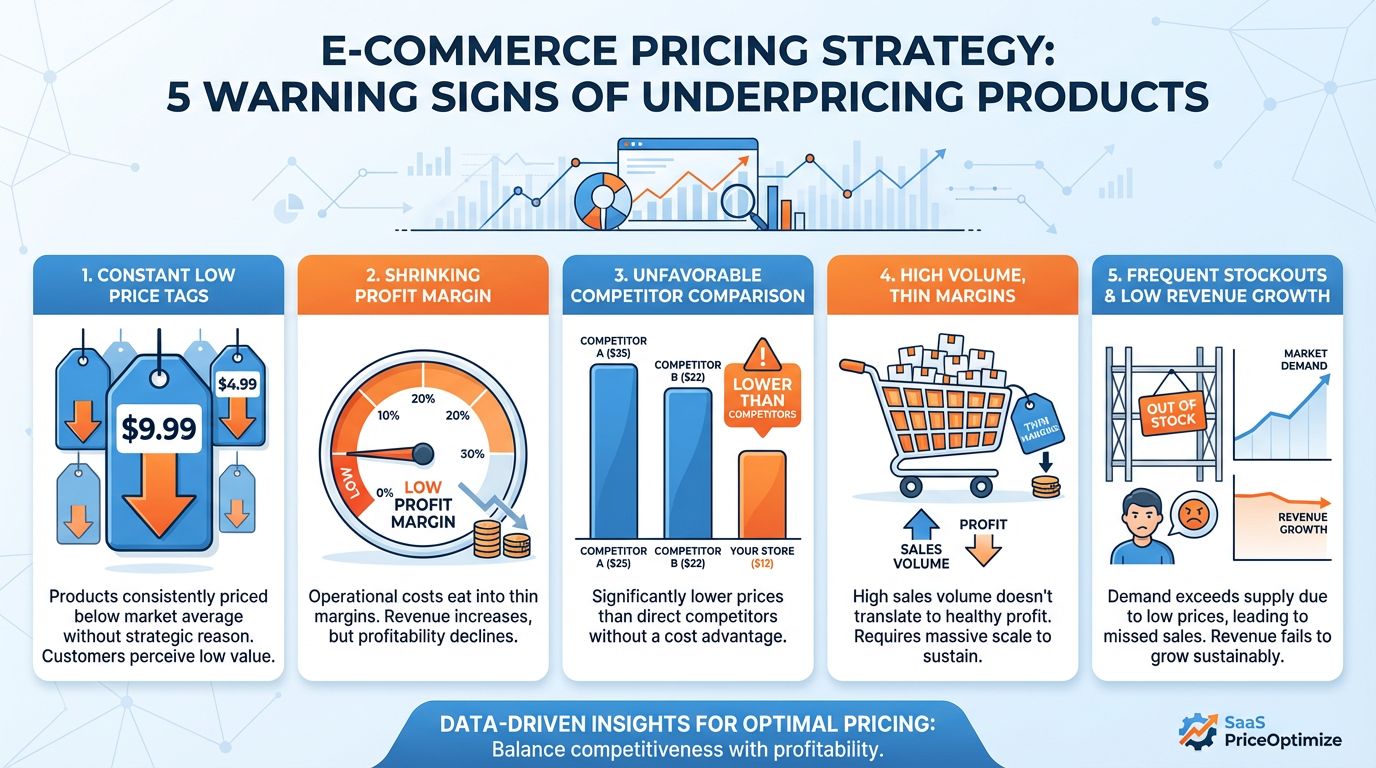
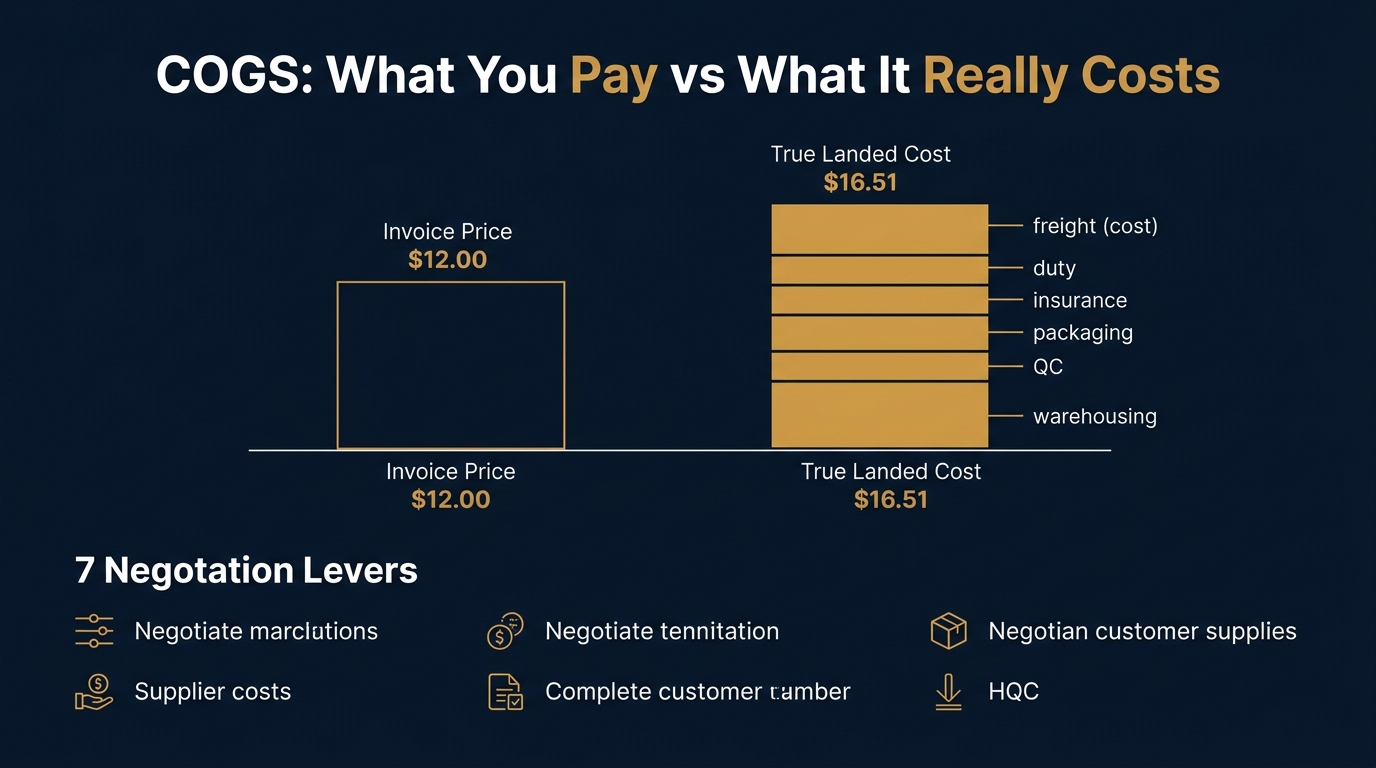
The average Shopify store uses one pricing method: cost-plus. They take COGS, add a markup (usually 2x-3x), and call it a day.
The problem is that cost-plus pricing:
- Ignores what customers are willing to pay (often more than you think)
- Creates arbitrary prices that do not hit psychological sweet spots
- Leaves 10-30% of margin on the table
Here are 7 tactics that fix this.
Tactic 1: Charm Pricing (The $.99 Effect)
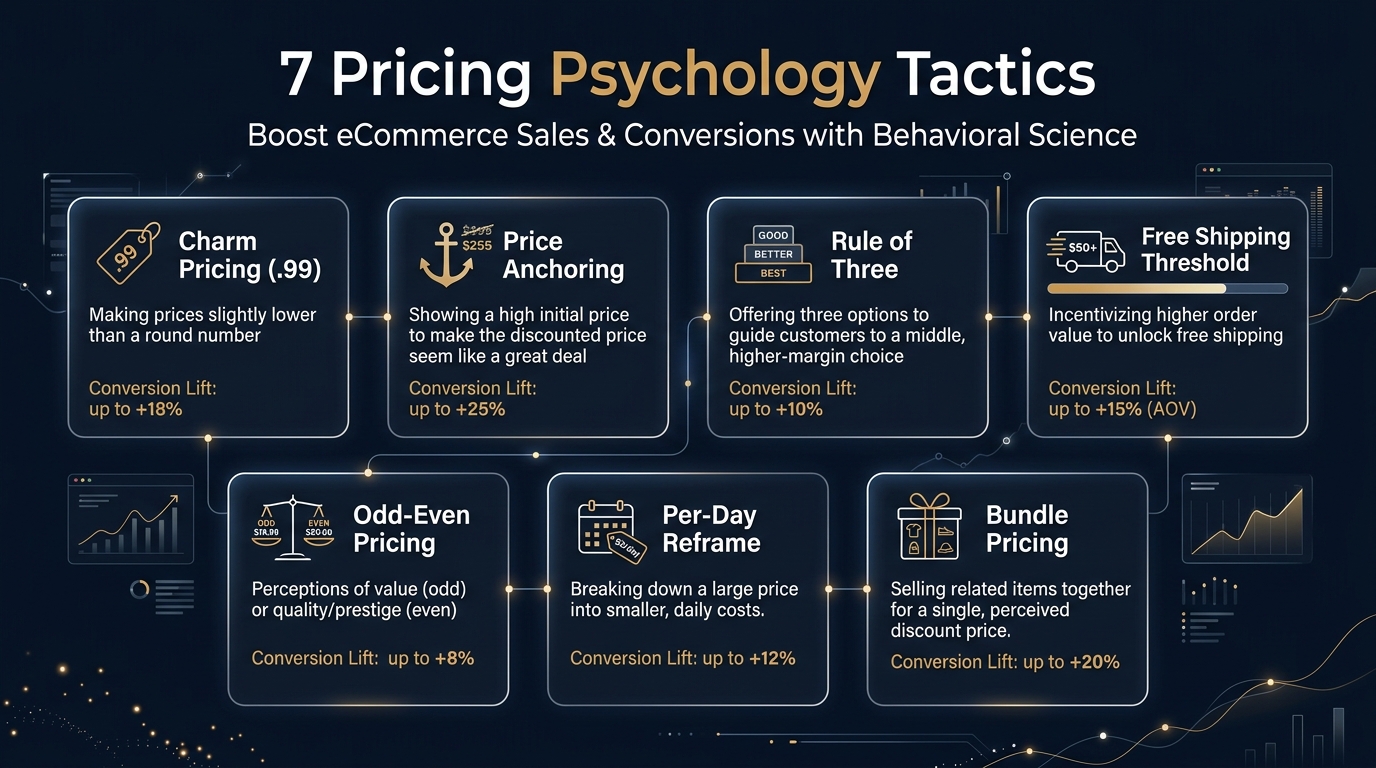
This is the most well-known pricing tactic, and it STILL works. Prices ending in 9, 99, or 95 convert better than round numbers.
Why it works: The left-digit effect. Our brains process $29.99 as "twenty-something" and $30.00 as "thirty." The perceived gap is much larger than $0.01.
When to use it:
- Products under $100: use .99 or .95 ($24.99, $49.95)
- Products $100-$500: use .00 or .95 ($149.00, $249.95)
- Premium products over $500: use round numbers ($500, $1,200) — round numbers signal quality
A/B test results from real stores:
- $25.00 vs $24.99 → 24.99 won by 8% higher conversion
- $50.00 vs $49.95 → 49.95 won by 12% higher conversion
- $200.00 vs $199.00 → 199.00 won by 6% higher conversion
Impact on your margin: Minimal cost (losing $0.01-$1.00 per unit) for 6-12% more sales. Net positive by a wide margin.
Tactic 2: Price Anchoring (The Decoy Effect)
Show a higher price first, and everything after it feels cheaper.
How to use it in ecommerce:
- Show the "Compare at" price (crossed out) above the current price
- List your premium product first in a collection page
- Show a bundle at full itemized price, then show the bundle discount
Example:
- Compare at: ~~$89.99~~ → Now: $59.99 (33% off)
- Same product. Same profit. But the $89.99 anchor makes $59.99 feel like a steal.
Important rules:
- The anchor must be believable. If your $20 product shows "Compare at $200," no one buys the anchor.
- If you use MSRP anchors, they must be real market prices (Shopify App Store compliance).
A/B test results:
- With anchor: 22% higher conversion
- Without anchor: baseline
- Margin impact: Neutral (you are not actually discounting from anchor)
Tactic 3: The Rule of Three (Good, Better, Best)
Offer three price tiers. Most people choose the middle one.
This is not just a SaaS pricing trick. It works for physical products too:
Example: Skincare Bundle
- Basic (1 product): $29.99
- Popular (3 products): $69.99 ← most people choose this
- Complete (5 products + bonus): $99.99
Why it works: The middle option looks like the best value when flanked by a cheap option (too basic) and an expensive option (more than I need).
How to set prices:
- Basic: Your standard price
- Popular: 2-2.5x Basic (but 10-15% less per unit than buying separately)
- Complete: 3-3.5x Basic (but 20-25% less per unit)
A/B test results:
- Two options (Basic + Complete): 60% choose Basic, 40% Complete
- Three options (Basic + Popular + Complete): 25% Basic, 55% Popular, 20% Complete
- Revenue per visitor: +31% with three options
Tactic 4: Free Shipping Threshold
"Free shipping on orders over $X" is the single most effective pricing mechanism in ecommerce.
How to set the threshold:
- 1Calculate your average order value (AOV)
- 2Set free shipping threshold at AOV + 20-30%
- 3Show a progress bar in the cart
Example:
- Current AOV: $52
- Free shipping threshold: $65 ("Free shipping on orders over $65!")
- Cart shows: "You are $13 away from free shipping!"
Results from real stores:
- AOV increase: 12-18%
- Cart abandonment decrease: 8-15%
- Shipping cost absorption: Easily covered by higher AOV
The math:
- Before: 1,000 orders × $52 AOV = $52,000, shipping cost $4,500
- After: 1,000 orders × $61 AOV = $61,000, shipping cost $6,200 (more free shipping)
- Net gain: +$7,300 revenue, only +$1,700 shipping = $5,600 more profit
Tactic 5: Odd-Even Pricing by Category
Different product categories respond to different price structures:
| Category | Best Price Ending | Example |
|---|---|---|
| Everyday consumables | .99 or .97 | $14.99 shampoo |
| Fashion / lifestyle | .00 or .50 | $45.00 t-shirt |
| Premium / luxury | Round numbers | $200 leather wallet |
| Electronics / tech | .95 or .99 | $149.95 headphones |
| Gifts | .00 | $50.00 gift set |
Why it matters: Odd prices ($X.99) signal value/bargain. Even prices ($X.00) signal quality/premium. Using the wrong one sends mixed signals.
Tactic 6: Per-Day Pricing Reframe
Instead of showing the total price, show the per-day cost.
Example:
- Instead of: "$29/month subscription"
- Show: "Less than $1/day for unlimited profit insights"
For physical products:
- Instead of: "$89.99 premium face cream"
- Show: "$89.99 — just $1.00/day for 90 days of glowing skin"
This works because $1/day feels trivial. $29/month feels like a bill. Same price, different framing.
When to use: Subscription products, high-price items, and anything you can divide into daily or per-use cost.
Tactic 7: Bundle Pricing (The Smart Discount)
Instead of discounting individual products, bundle them.
Why bundles beat discounts:
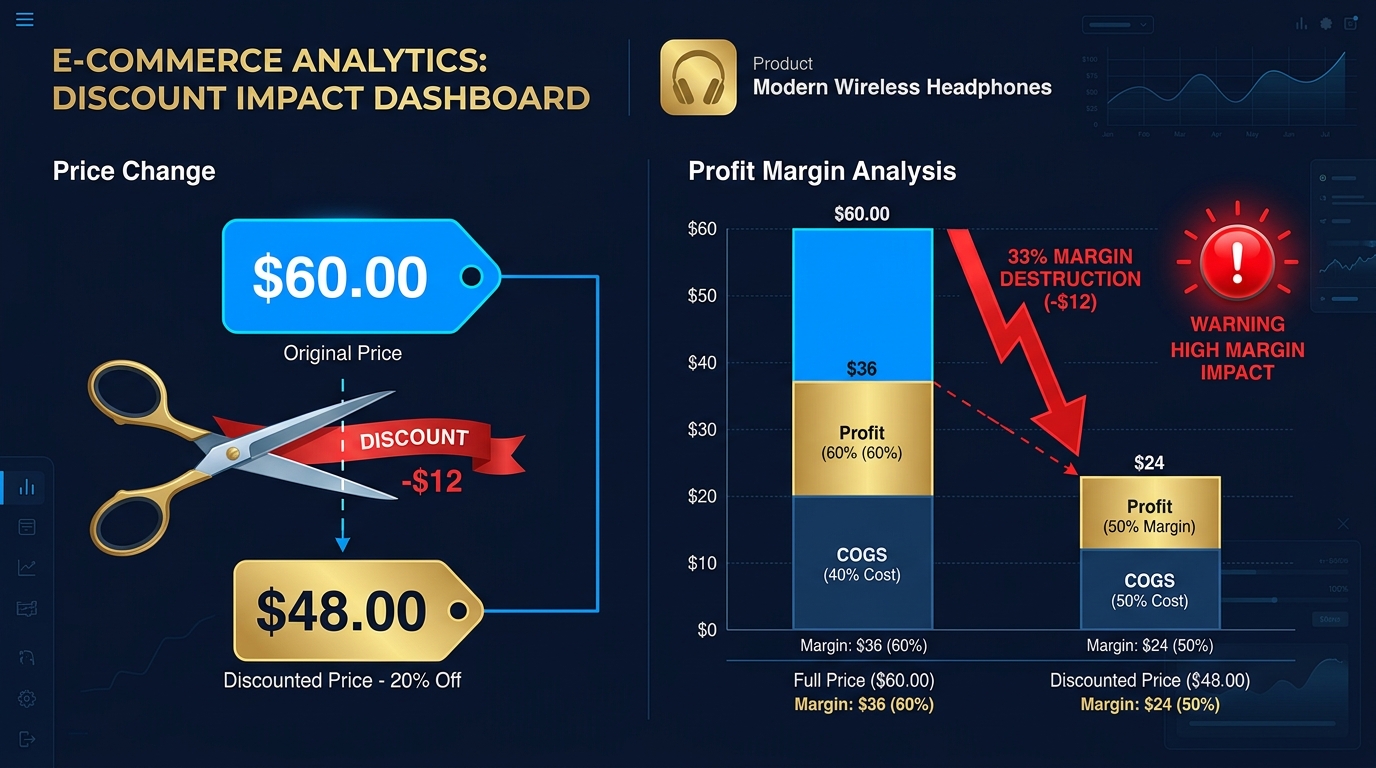
- Discounts train customers to wait for sales
- Bundles increase AOV without reducing perceived value
- Bundles move slow inventory alongside fast movers
Bundle pricing formula:
Bundle Price = Sum of Individual Prices × 0.80 to 0.85
So if Product A is $25 and Product B is $20:
- Individual total: $45
- Bundle price: $36-$38 (15-20% off)
- Perceived savings: $7-$9
- Your actual margin: Often higher because Product B has higher margin
Real example:
A supplements brand bundled their 3 best sellers:
- Individual: $29.99 + $34.99 + $24.99 = $89.97
- Bundle: $69.99 (22% off)
- Individual COGS: $8 + $10 + $7 = $25
- Bundle margin: $44.99 / $69.99 = 64.3%
- Average individual margin: $64.97 / $89.97 = 72.2%
Lower margin percentage, but 18% more bundles sold (higher total profit).
Putting It All Together: The Pricing Optimization Audit
Here is a 30-minute audit you can do today:
Minutes 0-10: Price Point Review
- List your top 10 products by revenue
- Check: are prices ending in .99/.95 for value items and .00 for premium items?
- Identify any prices that feel arbitrary (e.g., $37 instead of $34.99 or $39.99)
Minutes 10-20: Anchor & Bundle Check
- Do your product pages show "Compare at" prices?
- Do you offer a Good/Better/Best option for your hero products?
- Could you create 2-3 bundles from your top sellers?
Minutes 20-30: Shipping Threshold Analysis
- What is your current AOV?
- Is your free shipping threshold set at AOV + 20-30%?
- Do you show a progress bar in cart?
The Bottom Line
Pricing psychology is not manipulation. It is presenting your prices in the way that best serves both you and your customers. A well-structured pricing page helps customers choose the right product faster AND improves your margin.
Upload your Shopify data to Okiela (free, 3 analyses/month) to see exactly which products have room for pricing optimization. The AI will flag SKUs where your margin is below category benchmarks — those are your biggest opportunities.
Find the hidden profit leaks draining your store.
Send one order export. Get your 3 biggest profit leaks back within 48 hours.
Request a free Profit Leakage AuditFree, founder-run, no pitch unless you ask. Every number labeled Verified or Estimated. Remove customer PII before upload.
Enjoyed this article?
Get weekly profit optimization tips and Okiela product news delivered to your inbox.
No spam. Unsubscribe anytime.
Nguyen Tuan Dai
Founder & CEO, Okiela
FP&A analyst building ecommerce tools on the side. Helping founders see their real numbers since 2025.